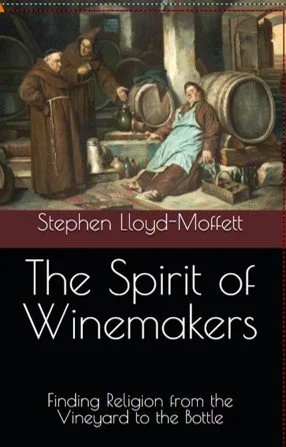
The Spirit of Winemakers
Finding Religion from the Vineyard to the Bottle
The Spirit of Winemakers explores the colorful spiritual lives of some of the most famous and interesting winemakers in the world. While few winemakers today pray to Bacchus or make their wine in monastic cellars, this book reveals that deeply held and sometimes peculiar spiritual beliefs still motivate many in the wine industry. From Jewish mysticism and Daoist philosophy to Zen meditation and Hindu-inspired crystals, there is so much more that goes into wine than just grapes. Grounded in over one hundred interviews across three continents, this study will open your eyes to the spirituality that shaped the wines you drink and invite you into the inner lives of the people who make the wines you love.

Click here to Purchase a Copy through Amazon
Table of Contents
Chapter 1: God’s Own Winemakers
Chapter 2: Drink Here, Now: Zen and the Art of Winemaking in the West
Chapter 3: Biodynamicism
Chapter 4: Spiritual (but not religious) Winemakers
Chapter 5: Wu-Wei Winemakers
From the Introduction:
Ursula was a wine grower in the McLaren Vale, South Australia when she had a vision that she was supposed to travel to the Himalayas. She left her vineyard in the hands of capable family members and traveled to find wisdom in the ancient mountains that top the world. When she returned, she personally eschewed drinking wine in exchange for purely spiritual sustenance, but she continued to make the divine juice for others. However, she was changed. She began to walk through the rows of vines touching each vine and telling it that she loved it. And she genuinely loved. Each vine. Each berry. Each leaf. She no longer merely cared for the vines, she communed with them. She also healed them (and people, by the way), even from a distance. They responded to this love by producing great fruit that was converted into ethereal wine.
She’s retired now but she still recognizes that in the world of wine, she probably marks the far edge of the fringe. She is right in one sense: modern winemakers are not known for being a spiritual bunch. Long gone are the days when winemakers called upon Dionysius to make fermentations happen; furthermore, it has been five hundred years since most wine was made by monks in monasteries. Rather, the average winemaker today is trained to be an oenological scientist working in sterile laboratories surrounded by the latest vinification technology. At times it seems that the only romance left in parts of the wine world happens with the grafting of a new clone, if the sex life of grapes can be seen as romantic. Wine journals today are filled with pithy verses about reverse osmosis and tantalizing exposés about the ROI and M&A of neighbor’s wineries. Glamorous wine events abound where winemakers pretend that they are comfortable in suits, conversing about ratings and auction values as if their wines were stocks and bonds rather than agricultural products. It is no wonder Ursula feels out of place in the modern world of wine. Yet, she really shouldn’t.
Under the shiny veneer of the modern wine industry, the people responsible for the wine have changed less than they let on. They may not pray to Dionysius anymore at vintage but there are winemakers who place written verses containing positive affirmations on their fermentation tanks to encourage their grapes or pray over every fermentation vat. Visit a winery during vintage and you may be able to hear, just above the coolant system, Gregorian monastic chant or for at least one notable person, a single musical note played live that is supposed to “energize” the wine. They will laugh if you ask them about animism (the idea that everything has a soul), but I lost track of the number of winemakers who told me they talk to their wines—and think they respond. Winemakers “heal” their wines by passing them through quartz crystals or aging them in pyramid-shaped vessels. I heard winemaker tales of sleeping on their cellar floor during vintage and waking every few hours, revealing a discipline and dedication that would make Abbots envious in years past. There is even an International Federation of Bacchanal Brotherhoods, a contemporary wine society that consciously links itself back to the piety (and the feudal system) of a millennium ago, that performs elaborate hidden rituals to initiate brothers (and now sisters) into a stream of winemaking traditions that dips far back into the recesses of history. In fact, when one starts scratching the surface, spirituality seems to sneak into wine almost as much as additives; but like additives, everyone likes to pretend it isn’t happening. Ursula just thinks she is alone.
This book is based on interviews with nearly a hundred winemakers around the world, who generally would rather talk for hours about the benefits or harm of extended maceration rather than talk for a few minutes about their personal spiritual beliefs. Undoubtedly, there are many winemakers who are utterly deaf to the spiritual side of life. Some of them still make great tasting wine and are incredibly successful at their trade. This book is not about them. It is about those for whom wine is more than just a job, even a job they really love; it is a calling. They are without question wine devotees but they are more than that: they have dedicated their life and placed their livelihood in the hands of wine. It is not merely a hobby or even an obsession but closer to a vocation—something they would do even if they wouldn’t get paid. While some were born into wine families, most of them experienced at some point an event that so transformed them that they could no longer continue their previous life’s trajectory. These are the spiritual winemakers.
Having asked them about their spiritual life, it is hard to tell if the world of wine has attracted some spiritual people or that if you make enough wine, you eventually end up seeking spirituality. Probably, it is a bit of both, with certain vintages driving people to their knees more than others. On the surface, the spiritual winemakers share very little in common. Some are Christians, some are Buddhists, some are atheists, and some just shrug their shoulders when I ask them their religious identity. They differ in age, sex, place, and personality. Yet they all hold that there is something bigger going on in the wine business than just hocking spiked grape juice. They all hold that some of the most interesting parts of wine are unmeasurable and unseen. And they share a belief that wine is part of their spiritual journey, not opposed to it.
In chapter one, we meet those who think God is behind all great wines and so they develop a theology of wine where they serve God through their oenological vocation. In chapter two, we turn to the east and look at winemakers who have been shaped by the religions of India, Hinduism and Buddhism. Chapter three is dedicated to biodynamic winemakers, for whom wine has a place in the overall cosmos that is critical for its proper cultivation. In chapter four, we turn to the “spiritual but not religious” crowd of winemakers, who eschew formal religious connections as they turn to the non-material parts of wine. Finally, in chapter five, the focus is on winemakers who do not necessarily fit into a traditional theology or system but have a strong sense that there is a natural harmony within wine that reveals itself when the human tendency for control is given up. I call these winemakers “Wu-Wei Winemakers” after the Daoist notion of active passivity in the pursuit of the Dao.
Nearly all the wine producers profiled in this section shun the term “winemaker.” They note that winemaker is only a new world term; there is not word for winemaker in French, Italian, or Spanish. Like a thoroughbred trainer coaxing the highest performance out of nature or the midwife who guides the natural process, these winemakers see themselves as shepherding the grapes as they reach for the highest expression of what they already are. Vigneron, a word that awkwardly translates into something like wine grower, is perhaps better but still alters the spirit of their task. If it hadn’t become so cliché, perhaps something like wine whisperer would be best. Whatever the name, these winemakers have a different relationship to the fruit of the vine than non-spiritual winemakers. The making of wine is not just a passion but it enters into the spiritual realm of life. The soul of wine has lodged in their hearts and souls. As a result, the wines of spiritual winemakers have become oenological expression of love.
Most winemakers may just want to make some “kick-ass booze” as one Australian told me. Spiritual winemakers are not opposed to that goal either. However, they want something more from their relationship to wine. In ancient Greece, they would read the leftover lees as clues to Fortune; they were a conduit to the spiritual dimension. Spiritual winemakers want the same: for wine to become a conduit to the fourth dimension: spirit. And so when they press their grapes or rack their barrels or fill their bottles, they offer not just their brawn and brains to the process but their heart and their soul. The resultant bottle reflects not just their winemaking technique but also their love, which they long to share with others.
Ursula, the Australian winemaker who caresses each one of her vines, undoubtedly loves her vineyard. Each vine. Each leaf. Each berry. Anyone could tell who watched her weekly vine-caressing ritual. Yet she also found something more through her wine, through her love. Perhaps we should call it oenological illumination. So, grab a glass of wine as you read, for the goal of this book is to convey the transformative power of bottled love with you, the reader.
Excerpt from the chapter on Wu Wei Winemakers in the Spirit of Winemakers
...Lafarge, Labet, Millet, and de la Morinier are representative of a new Burgundy that stands in contrast to the manipulated vineyards and wines of the 1980s and early 1990s. There seems to be a revolution of active non-activity. Andrew Jeffords describes it in New France: “In winery terms, France is a giant experimental laboratory of inaction at present—willed inaction, understood inaction, observed inaction—and it is this, together with dramatically reduced yields and healthier vineyards, which has spawned a new generation of wines of shattering articulacy and strange beauty. It often requires daring: doing nothing is sometimes the winemaker’s equivalent of exhibition acrobatics, of pulling out of the dive at the last possible moment, of skimming the tree line with a shaking fir cone to spare.” While often linked to ‘traditional’ winemaking, Jeffords is right to note that it is something new. The methods might be the same as a hundred years ago, but there is now an awareness and deliberateness that was absent previously. The vinological zeitgeist has shifted dramatically. Perhaps the motto of this movement is captured by a phrase that is attributed to the late Rene Lafon of Meursault, but relayed to me in nearly every interview in Burgundy: “you have to have the courage to do nothing.” The “courage to do nothing” does not mean, the vignerons assured me, that they heaved the grapes into vats and awaited bottling. Rather, they practice what Fred Mugnier calls a “philosophy of subtraction.” Reflect upon every action and then eliminate anything that is trying to force the wine into a predetermined mold. Let the terroir speak through the wine, not the winemaker. Act only when necessary to restore the conditions for a wine to reach its destiny. Embrace harmony. Have faith in the grapes. This is the new Burgundian Creed that I heard throughout the celebrated hillsides of gold and beyond.
The most visible prophet behind this clarion call is Aubert de Villaine of Domaine Romanée-Conti . Even among the celebrated cast of the new gilded Burgundian aristocracy, de Villaine stands out as a living legend. He is the elder statesman, esteemed sage, and venerable saint. For a wine lover, walking into DRC for an interview with de Villaine is like walking into the Sistine Chapel for an audience with the Pope, though with the promise of better wine at the conclusion. In fact, the winery is appropriately a converted monastery that, while it may now be lined with modern glass and beams, still appropriately retains an air of its original sanctity. Passionate about the restoration of the monastery, De Villaine himself reminded me of many of the monks I’ve known in my life: quiet, studious, and humble yet oozing gravitas and integrity. Yet, as we spoke, he emerged as the paradigmatic wu wei Burgundian winemaker whose wisdom comes out so effortlessly that one could hardly be judged for thinking it is closer to revelation.
If a domain is not a location or a business but “a philosophy,” as de Villaine has argued, then the epistemic foundation of Domaine Romanée-Conti is found in the notion of climat, the Burgundian word for the terroir specific to small, designated plots of land. De Villaine is quick to point out that the source of DRC’s greatness is found primarily in the land itself, not in their skill as winemakers. In the world of celebrity winemakers, this perspective is both rare and refreshing. He told me, “Each year, you give birth to a wine where you must act but you know that the talent and the soul does not come from you but it comes from something beyond you that is stored in the land that you were given. It is a real school of humility.” The climat for de Villaine, then, extends beyond just the physical properties typically associated with terroir, even if these are profoundly influential. Climat is also a receptacle of history, so that efforts of countless nameless monks who labored in DRC’s fabled vineyards are not just historical footnotes but rather their energy and spirit inform the grapes today. While de Villaine does not want to take away from the centrality of the immediate climatic conditions of a particular vintage, he suggests that those who are attuned to it can also “taste the history.” This statement is meant to suggest not only that the vineyards today represent the culmination of hundreds of years of human cultivation but also that there is some non-material essence presence that works its way into the wine. He calls it the “soul” of the wine. Burgundy’s uniqueness derives from its ability to capture this soul quality. “The difference between the wines of Burgundy and other wines is the soul of the wine,” he tells me. “And the soul is given by the terroir. Many places around the world make wine with Pinot Noir and many of them are very good wines but they don’t have the soul like we have in Burgundy that comes from our terroir, from our history.” Thus, de Villaine approaches the vines as complete entities, with a material ‘body’ and a soul, to which one has a responsibility. He once told a wine writer, “We are at least as much the keepers as the owners of our terroirs (since they possess us as much as we possess them).”[ii]
The importance of the non-physical elements to the vineyard was evident for de Villaine in a story that he recalls from before he ran the domaine. The vines of the most fabled vineyards, Romanée-Conti, were perhaps hundreds of years old in 1945 and were becoming unproductive and vulnerable to the phylloxera pest, since they were some of the few vines not to be replanted around the turn of the century when most of France’s vines were grafted onto American rootstock to confront the phylloxera plague. The decision was made to rip out the most hallowed vines in the world. For various reasons, they were not replanted until 1947 and the first vintage under the new vines were from 1952. Normally, young vines produce inferior wines, however the 1952, 1953, and 1954 DRC are among the best in the century. De Villaine asked the director of the vineyard how he could explain the 1952 miracle? His response was a form of reincarnation: that the old root system was mulched into the soil when the new vines were planted and the soul was transferred to the new vines. The vines may have been physically young but they retained an “old soul.”
De Villaine’s deep awareness of history and his sensitivity to the non-material essence of the wine provides for him a more expansive and meaningful framework for his work compared to other wine makers. He is not just harvesting a fruit or manufacturing a product but has a wider cosmic purpose that is intimately tied to revelation of harmony inherent in the land. De Villaine once remarked in an interview:
For the monks of Cluny, who were in the Middle Ages owners of most of the “grands crus” of the Domaine and of Vosne in general, ars (only roughly translatable as art) had as a function and as a goal not the creation of a product that would have a market value, but rather the restoration of harmony to the world through the high quality of the work. The role of the vigneron, as artisan and artist, is to make visible in the wines that he produces the harmonious structure of the world, that is to say the harmonious structure as revealed by the terroir. Man remains the essential, indispensable translator, the humble interpreter of a harmony that fills, if one knows how to listen to it, the world created (at least for the monks and for many others still today) by God.[iii]
Harmony, he believes, is inherent in the cosmos. If he had been Chinese rather than French, he probably would have used the term the dao, which functions in the same way. Regardless of what one call it, his task is to reveal it, not to create it. In fact, the task of the winemaker is to carry that harmony into the bottle to share it with the world.
The word de Villaine prefers is ‘transparency’: the terroir should be transparent in the bottle, not the will of the winemaker. The production of great wine is always a partnership with the climat, but the winemaker is the junior partner. Success comes from the junior partner disappearing into the corner to allow the senior partner to shine. This task is little different from the monks that worked the land for a millennium. “When the monks were making wine here,” de Villaine notes, “they sought to be at the level of what God created. They were given these vines and were trying to make the wine as great as possible. Just as when they pray or act in their life, they want to be as close as possible to perfection, to God.” Despite working out of a monastery, de Villaine may not be traditionally religious but his aims seem quite parallel. De Villaine feels a deep sense of responsibility to something greater than his shareholders or even his industry. He is carrying on the traditional spirit of the monks, who were conscious that their winemaking was for a greater purpose.
De Villaine finds himself in a continual dialogue with Nature. The paradigm is found in the monks who worked closely with the land, believing that it was a mechanism for the communication of God’s will. As wine writer and critic Alan Medows noted about DRC, “God was speaking to them though messages sent from the earth.” De Villaine shares such sentiments, noting that they speak much like a child, however. “When you have a child, he doesn’t tell you what he needs but there is some form of communication so that you come to realize what he needs…the vines may not speak, but they tell you what they need.” De Villaine and his team thus spend a lot of time in the vineyards listening. They are waiting to hear the subtle signs to which they can react. “The role of the winemaker is to enable the terroir to be in the best condition possible–to help bring forward (like a mid-wife) the product of the exceptional land. The role is to listen to the terroir. One listens always to the terroir to understand what to do to achieve an equilibrium in the soil, what to use as vegetal material, how to prune, how to treat the vines. There is always a selection of the best methods so that the terroir is in its best disposition possible to make a good wine. One should not get the impression that DRC does not have a plan or that they merely meditate over the vines until the sheers begin pruning themselves. Rather, their plan is the result of an iterative process whereby they proffer an idea, listen to vines, read the climatic conditions, and adjust the plan accordingly. It is true dialogue, not a series of rigid directives.
Perhaps the most important element is the attitude that informs this dialogue. “Like the monks who had an attitude of prayer,” de Villaine begins, “you do things for the vines rather than do things for yourself….if there were two ways of doing things and one was easier, you would do what is best for the wine rather than what is easier for you, if you love the vines.” This attitude is thus marked by the subordination of the ego. Winemaking is not about heroically creating something, but humbling serving something greater. He is not making the wine, but caring for it as it makes itself. De Villaine’s favored analogy for his task is the midwife, whose role is not to create the baby or even to force the baby to emerge but rather guides the natural process along to its conclusion. While the midwife is important, she should not be the focus of attention. Neither should be the winemaker. “The winemaker’s signature should be the lack of a signature,” de Villaine told me (who nonetheless places his signature on his wines for counterfitting purposes). He is trying to actively remain passive, wei wu wei. He summarized this philosophy to another author, “We try not to get in the way.” When you open a bottle from DRC, it should be the voice of the climat you detect, not the winemaker’s.
As with many religious worldviews, the wine maker’s task for de Villaine ultimately widdles down to love. “The love you bring to the vines and to the wine you make is very important to the soul of the wine,” de Villaine confesses, “There will be no soul in the wine if there was no love in it as well.” In the end, it is love, actually. Such a statement from anyone else in the cynical modern world of wine would come across as primarily crass marketing, yet from him, it seems closer to a reflection of his heart and a perhaps a humble plea to world. Or perhaps it is revelation. The secret of DRC may not be found in its soil but in the love from its people, not just de Villaine but the thousands of monks who worked his vineyards before him with whom he identifies. DRC is a product of 1200 years of love; no wonder it is so expensive. Walking into his monastic offices, it is not a message that I expected but it was a fitting conclusion from one I was told was the sage, statesman, and saint of Burgundy: the soul of wine comes from an overflow of love. It is the secret of Burgundy and perhaps those who share their spirit around the globe.